Tuesday, 29 June 2021

Cathedral crossing


Most medieval cathedrals in Britain have a ground plan that is essentially a Latin cross. There are additions to this basic shape in the form of cloisters, chapter house etc, but in essence the footprint of the building is a Latin cross with the shorter head (the chancel) at the east, the longer nave at the west, and the north and south transepts making the two "arms". The point where the transepts meet is called the crossing and above this point (usually) is the cathedral's biggest tower - the crossing tower. Such is the plan at Hereford. Today's photograph shows the view from the north transept looking across the crossing to the south transept.

photo © T. Boughen     Camera: Nikon D5300

Sunday, 27 June 2021

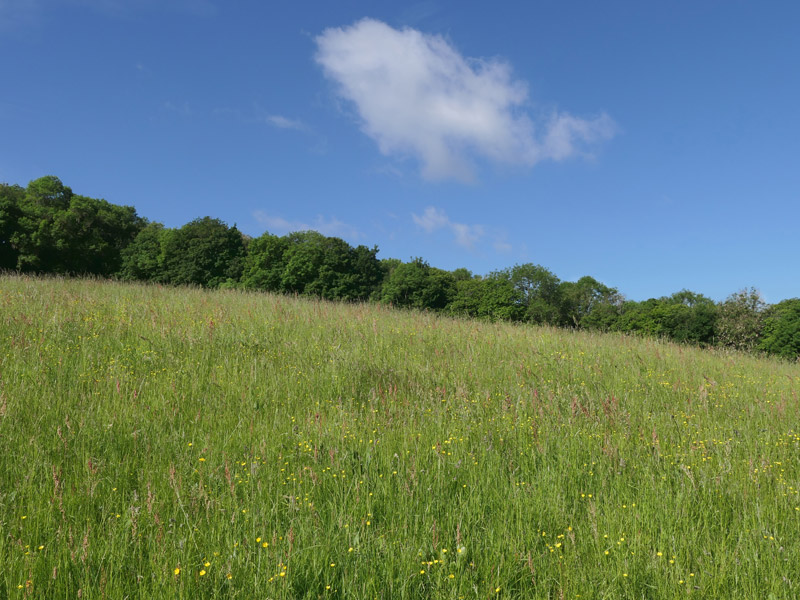
Meadow, trees, cloud


Sometimes it is the simplicity of what a day can offer is all that is required for a photograph. Featureless blue or grey skies are my least favourite "simple" element. But when an empty blue sky is broken by just one or two passing clouds that is enough to combine those elements with one or two others to make a photograph. As we toiled up a footpath through a hillside meadow the cloud over the nearby wood, combined with the grasses around us was enough for me to want to record the moment.

photo © T. Boughen     Camera: Lumix FZ1000 2

Friday, 25 June 2021

Ghost advertisement?


On a recent visit to Monmouth I noticed this "ghost advertisement", the residue of an old advert of, perhaps, Edwardian or Victorian origin, that had been uncovered by a later workman and kept for its historical interest. It reads: "Support Home Industries, J. Hillman Milliners, Extra Quality Silk Hats, Unequalled for Hard Wear, Always in Stock". The time when people required a silk hat at all, never mind one that is hard wearing, is long past, so I presumed the advert was quite old. An internet search, however, revealed something different. Apparently it dates from 2004 when BBC TV was filming a "Doctor Who" episode, "The Unquiet Dead" in the town and presumably needed to make the location fit the year 1869 in which the story was set. Not a real ghost advertisement and not old at all!

photo © T. Boughen     Camera: Lumix FZ1000 2

Wednesday, 23 June 2021

Industrial units and petri dishes


When I looked over the fence at these industrial units in Ross on Wye what caught my eye was the lines on every surface - on the walls, on the ground and even in the sky. On the ground I liked the way the parking bay lines ran the opposite way to the lines on the near metal walls. When I looked closer I realized the aircraft vapour trails paralleled the lines on the distant unit. Then I counted the vapour trails and lamented that the number of such trails seemed to be increasing daily, a sign that more and more people were putting their own self-interest and desire for a foreign holiday above the world's wider interest and I imagined each aircraft that passed over as a flying petri dish.

photo © T. Boughen     Camera: Nikon D5300
Monday, 21 June 2021

Socially distanced seating, Hereford Cathedral


The Covid19 pandemic has made us all very aware of the importance of social distancing. Recently we came upon an example of social distancing that made me stop and stare. The nave seating of Hereford Cathedral had been arranged with this in mind and, after decades of seeing naves with tightly packed seating separated only by necessary aisles, it looked decidedly odd. Adding to the oddness is the choice of inexpensive moulded plastic seating. Presumably this was chosen for ease of cleaning.

photo © T. Boughen     Camera: Nikon D5300

Saturday, 19 June 2021

Elgar in Hereford


The composer, Edward Elgar (1857-1934) is much celebrated in the west of England. He was born in the village of Lower Broadheath near Worcester and spent much of his early life near or in that city, and in London. He wrote for and had music performed by the Three Choirs Festival (Worcester, Gloucester and Hereford) as well as by Birmingham festivals. London saw many first performances of his major works. Between the years 1904 and 1911 he lived in Hereford in a house called Plas Gwyn. His connection with that city is celebrated by the 2005 bronze sculpture of the composer by Jemma Pearson near the cathedral. It shows him with his Sunbeam bicycle, for many years his preferred method of transport around the countryside he loved.


photo © T. Boughen     Camera: Nikon D5300

Thursday, 17 June 2021

Art glass bowl


Every now and then we buy a piece of art that takes our fancy. Today's photograph shows the interior of an art glass bowl by Paul Barcroft, one of a pair, that we bought in a now defunct gallery. The other bowl has a similar pattern in sea greens and blue. It wasn't immediately obvious where they were best placed to show off their beauty. However, our current house has a south facing window in the living room and the direct sun falling on the bowls make them positively glow.

photo © T. Boughen     Camera: Olympus OMD E-M10

Tuesday, 15 June 2021

Hereford Cathedral cafe arabesques


After having a walk around Hereford Cathedral recently we decided to have a cup of coffe in the cafe. This is housed in part of the building overlooking the ruined cloisters. It was early in the day and we were the only customers so I took advantage of the absence of people and searched around for a photograph. This view appealed to me for the delicate intricacy and arabesques of the metal work and its shadows as they fell across the floor. The whole effect reminded me of the Moorish work we have seen in Seville.

photo © T. Boughen     Camera: Nikon D5300

Sunday, 13 June 2021

Great Malvern "Gothick"


"Gothick" with the added "k" signifies the Georgian or early Victorian application of medieval Gothic styling to a building. It isn't an attempt to convince the onlooker that the eighteenth or nineteenth century building is genuine Gothic so much as a celebration or revival of the decorative motifs of the earlier period. In England the 1749 house called "Strawberry Hill" by Horace Walpole is widely regarded as the building that sparked the later "Gothic Revival". The building above, "Oriel House" on Worcester Road, Great Malvern, dates from around 1830 and exemplifies the self-conscious application of ogee doorway, trefoiled pilasters, crocketed pinnacles, battlements and square drip moulds. The oriel window that gives the house its name must be at the back to take advantage of the view across the Severn Valley and the distant Cotswolds.

photo © T. Boughen     Camera: Nikon D5300

Friday, 11 June 2021

Oak Meadow, Ross on Wye


In the centre of the view from The Prospect in Ross on Wye is Oak Meadow, a big field that fills much of a large meander of the River Wye. It is named after the old oak tree at its centre, presumably planted as shade for farm animals that used the field. Photographs of the field taken in 1886 show the "rare old oak" and local attempts to age the now split and partly hollow tree are many. It has been called the "Domesday Oak" suggesting it dates from around 1087 when the Domesday Book was compiled. Attempts to link it to the time of Elizabeth I or Henry VIII suggest an age of 500 or 600 years. All this is speculation without the support of dendrochronology. As we looked out from The Prospect recently we noticed the farmer taking what appears to be the first steps in erecting fencing around the oak, as protection from animals and farm vehicles perhaps, steps that will help ensure it continues for many more years.

photo © T. Boughen     Camera: Lumix FZ1000 2