Friday, 30 April 2021

English Civil War soldier


Every now and then I come upon a photoshoot with a photographer, assistant and model(s) making use of a location as a backdrop. It happened again recently when we were at Tewkesbury Abbey in Gloucestershire. In the grounds, using the ancient walls as a setting, was a model in what appeared to be the dress of a soldier from the time of the English Civil War. The sky was cloudless and the photographer was using the shade of a conifer supplemented by a reflector held by his assistant to light his subject. From a distant bench, with my lens extended to its maximum I took a quick snap of the soldier whose appearance reminded me somewhat of the English actor, Brian Blessed, in the film, "Flash Gordon"(1980).

photo © T. Boughen     Camera: Lumix FZ1000 2

Wednesday, 28 April 2021

Disturbed reflection, Tewkesbury


Tewkesbury's Borough Flour Mills, also known as Healings Flour Mill and Warehouses, stands derelict by the River Avon. The buildings date from 1865 but an earlier mill in the seventeenth century stood at this location, and it is certainly possible that the two mills recorded in Tewkesbury's entry in the Domesday Book (1086) may have been situated here. So, perhaps other people have stood where I stood the other day and enjoyed watching the reflected image of the mill being disturbed by the passage of a drake mallard.

photo © T. Boughen     Camera: Lumix FZ1000 2

Monday, 26 April 2021

Unexpected colours


Generally the colour of water relates to what lies beneath or to its surroundings - the colour of the sky or overhanging trees, for example. However, sometimes it is an unexpected tint. In the photograph above the green doesn't seem to correspond to any reflected objects but does sit nicely as a complement to the buff of the reeds and the blue of the cloudless sky. In fact had the green not been there I probably wouldn't have taken the shot.

photo © T. Boughen     Camera: Sony DSC-RX100

Saturday, 24 April 2021

Altar reordering


In the second half of the twentieth century the Church of England began to come to terms with declining numbers in their congregations and a desire to have less separation between clergy and laity. Part of the response to these changes was to have an altar at the east end of the nave (or at the west end of the chancel). This brought the presiding priest closer to the worshippers rather than being distant, at the east end of the chancel near the high altar. However, the high altar was usually retained and the new altar could not be allowed to outshine it. The church of St Mary, Ross on Wye, illustrates this solution. A modest altar has been placed at the west end of the raised chancel. It has no permanent frontal, cross etc. but signifies its presence very effectively by being lit underneath. 

photo © T. Boughen     Camera: Lumix FZ1000 2

Thursday, 22 April 2021

Broad Street, Hereford


Broad Street, Hereford, features a number of interesting and distinctive buildings. Prominent in the view above is the Public Library, Museum and Art Gallery housed in a Venetian Gothic building of 1872-4 by F.R. Kempson. The adjacent buildings, with the exception of that on left, share nothing in common except the same gutter height which is enough to hold the composition together. The modern building with blue tinted glass is faced with a brown stone that helps it to sit fairly comfortably next to its venerable neighbour. Thereafter it is the pale colour that links a sequence of new and old buildings before the street view is "closed" by the medieval tower and spire of All Saints on the High Street.

photo © T. Boughen     Camera: Nikon D5300

Tuesday, 20 April 2021

Pheasant in the garden


Recently we had a cock pheasant (of the ringed-necked variety) in our garden. It stayed long enough to explore and feed on the fallout from the seed dispensers. It was the first pheasant to visit the back garden since we moved into the house. At our previous house pheasants were reasonably common. One cock bird took to roosting in a conifer in our garden one winter. It would arrive each evening with a loud call as it took up it place in the branches. At the house prior to that one I went out of the front door one day and disturbed a golden pheasant that was rooting about in the shrubbery - a very unusual sight outside of an aviary or specialist collection, and one that makes the sight of a common pheasant seem even commoner.

photo © T. Boughen     Camera: Nikon P900

Sunday, 18 April 2021

Hop kilns near Ledbury


What are known as oast houses in Kent are, apparently, called hop kilns in Herefordshire. The photograph above shows two hop kilns (one behind the other in this view) adjoining Kiln Cottage near Frith Wood, Ledbury. The purpose of oast houses/hop kilns was to dry the hops grown for beer-making which are then sent to the brewery. Today this is done in machines and the distinctive buildings that formerly punctuated the landscape in hop growing areas have fallen into disuse or been converted into additional living accomodation. The examples above are now picturesque parts of a cottage that may well have originally been a functional building associated with hops. The spring woodland is showing a variety of subtle colours and the prominent mistletoe ball, above the cottage's gable end, that has been revealed all winter will soon be hidden by leaves.

photo © T. Boughen     Camera: Lumix FZ1000 2

Friday, 16 April 2021

Whitecliff Ironworks and the Mushets


In 1810 David Mushet, a leading metallurgist, and his family moved from Derbyshire to Coleford in the Forest of Dean to try to turn the Whitecliff ironworks into a paying proposition. In this endeavour he failed, but the Mushets remained in the area and in time, through their Darkhill Ironworks, advanced the manufacture of iron and steel in ways that had a national and international impact.


On a recent walk we took in a visit to the furnace that is the principle remains of the Whitecliff works. It is in a narrow valley and is accompanied by several other stone and brick structures. We also went into Coleford to see the rather fine mural that celebrates David Mushet and his son, Robert, the "Men of Iron and Steel". 

photo © T. Boughen     Camera: Lumix FZ1000 2

Wednesday, 14 April 2021

The Man of Ross inn


The "The Man of Ross" inn can be found at the top of Wye Street in Ross on Wye. It dates from the seventeenth century and has been extensively rebuilt and refaced. Today the Dutch gable above the main entrance carries a tribute to the man himself, John Kyrle (pronounced "curl"). This is what it says:

John Kyrle (1637-1724)
Gained Fame for His Community Involvement
His Modest Life Style and Charitable Works
He Helped Settle Disputes, Aided the Poor & Sick
Supported Schools and Left the Beautiful "Prospect" Walk
with a Fountain and Garden to the Citizens of Ross.

THIS IS ONE OF THE FIRST RECORDED ATTEMPTS IN THE COUNTY
TO BEAUTIFY A TOWN FOR THE BENEFIT OF ALL THE PEOPLE

photo © T. Boughen     Camera: Lumix FZ1000 2

Monday, 12 April 2021

Darkhill Ironworks, Forest of Dean


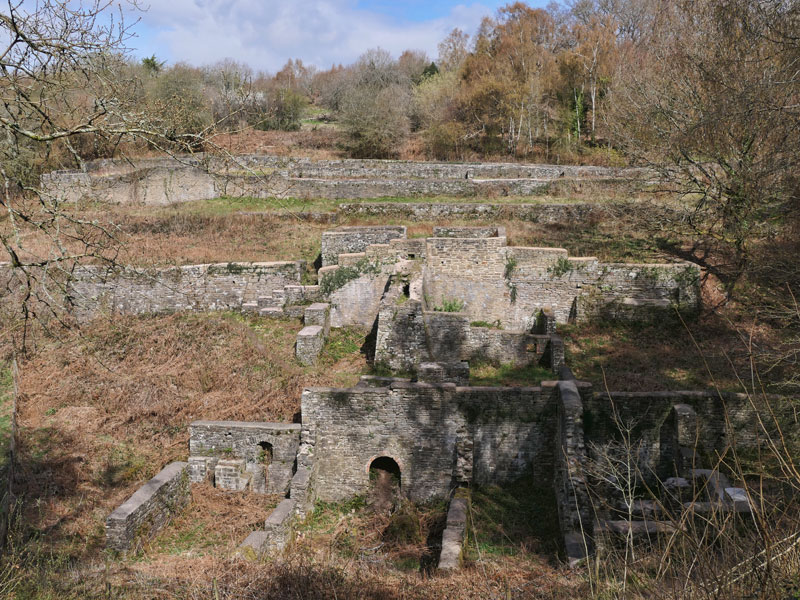
David Mushet began the Darkhill Ironworks, producing iron, near Coleford in the Forest of Dean, in the year 1818. His son, Robert established another ironworks nearby. Together they worked out how to make steel cheaply in larger quantities. In 1856 Robert perfected Henry Bessemer's process for making good, cheap steel. The first tungsten steel was made in 1868 by Robert and he built the Titanic Steelworks a few hundred yards from the Darkhill site to produce it.


The remains of the Darkhill Ironworks and the Titanic Steelworks were uncovered in 1979 and made available to the public as a reminder of the pioneering work in iron and steel that is a feature of the Forest of Dean.

photo © T. Boughen     Camera: Lumix FZ1000 2