The passion flower (Passiflora) in today's photograph was one of many in a large drift of the plant that grew up a wall and across the ground in the centre of a town. Our success with this plant is fairly limited and, perhaps connected with that, it isn't one of my favourites. It is , however, very popular and comes in many colours. The flower is something of an oddity and in no way connected with passion in the sense of love or emotion, but rather, with Christ and his suffering surrounding his death. The medieval mind saw in the flower, and the plant in general, symbols connected with that event. Rather than me list them here is what Wikipedia says:
"The pointed tips of the leaves were taken to represent the Holy Lance.
The tendrils represent the whips used in the flagellation of Christ.
The ten petals and sepals represent the ten faithful apostles (excluding St. Peter the denier and Judas Iscariot the betrayer).
The flower's radial filaments, which can number more than a hundred and vary from flower to flower, represent the crown of thorns.
The chalice-shaped ovary with its receptacle represents a hammer or the Holy Grail.
The 3 stigmas represent the 3 nails and the 5 anthers below them the 5 wounds (four by the nails and one by the lance).
The blue and white colors of many species' flowers represent Heaven and Purity.
In addition, the flower keeps open three days, symbolising the three years' ministry."
photo © T. Boughen Camera: Lumix FZ1000 2
Wednesday, 19 August 2020
Monday, 17 August 2020
Duck Houses, Newent, Gloucestershire
Mention duck houses to the man in the street in the UK and the discussion is likely to refer to the Conservative Party Member of Parliament who, in 2009, claimed the cost of one (£1,645) on his parliamentary expenses form. As I recall, his career as a representative of the people ended when he stood down at the subsequent general election. I don't know how much these duck houses cost but they appear to be well used, unlike the MP's - he said the ducks never took to it. What I find slightly surprising is the purple loosestrife that has managed to grow and bloom on these floating houses. Presumable the copious manure from the mallards and moorhens are all that is required to give the plants the foothold they require.
photo © T. Boughen Camera: Olympus OMD E-M10
Saturday, 15 August 2020
Upleadon Court, Gloucestershire
Upleadon Court is a large brick farmhouse with nearby barns that forms a visual group with the church (see photograph below). The main building has a hipped roof, dormers, and modest windows and door. It dates from the eighteenth century. The adjoining timber framed wing is of the seventeenth century. There is a suggestion that the farmhouse was rebuilt after a fire, something that would explain the awkward juxtaposition of the older wing if it was all that remained of the original building. The framing of this structure is typical of the west of England with its square layout of timbers and absence of close studding.
photos © T. Boughen Camera: Olympus OMD E-M10
Thursday, 13 August 2020
St Mary the Virgin, Upleadon, Gloucestershire
The church of St Mary at Upleadon, Gloucestershire stands about a mile from the centre of the village next to an old farm. The nave is of the Late Norman period i.e. c.1150 and a round-arched doorway of that time can be seen in the photograph. For the church architecture enthusiast the striking feature of its exterior is the tower, a structure of probably c.1500. It stands on a stone plinth with, above, a timber frame of close studding filled with bricks on all but the east face which is stone.
The pyramidal cap is of green slate. Unusually, the timber frame has no exterior diagonal bracing. Inside the building the framing is visible - cross bracing, heavy timbers, and a belfry floor. The building was closed when we visited but we will return during its brief open period. Incidentally, the dry spring and summer, with attendant high temperatures continues and the sheep in this seemed to have about as little energy as we did.
photos © T. Boughen Camera: Olympus OMD E-M10
Tuesday, 11 August 2020
Stinging nettle
The stinging nettle (Urtica dioica) is one of the most common and widespread of British wild plants. It is one of a small number of plants, that includes cow parsley and cleavers (goose grass), that have benefitted from the nitrogenous acid rain that was and still is a feature of industrialisation. Children find its sting a source of pain though to most adults it is merely an irritation. There was a time when the nettle was always in the list of those to be planted or enouraged when making an area more wildlife friendly. However, none of the butterflies for whom it is a major food source are in danger, and it is increasingly the view that we have quite enough nettles and there are other plants more deserving of inclusion. These nettles were part of a group thriving in some woods and once again the light filtering down through the leaf canopy above made the composition.
photo © T. Boughen Camera: Lumix FZ1000 2
Sunday, 9 August 2020
All Saints, Brockhampton, Herefordshire
All Saints church at Brockhampton near Ross on Wye, was built in 1901-2 by W.R. Lethaby. The architectural historian, Nikolaus Pevsner describes it as "one of the most convincing and impressive churches of its date in any country." The clerk of works was A. Randall Wells, the architect of nearby St Edward the Confessor at Kempley, Gloucestershire. All Saints was built in the Arts and Crafts tradition, and, like Kempley, its style is a modernized Gothic. Unusually for a small parish church it has two towers, with the bells in the wooden tower over the porch rather than over the crossing. The building is thatched and has an interior as unusual and impressive as its exterior. Unfortunately, at the time of my recent visit, it remained closed due to the coronavirus.
photo © T. Boughen Camera: Olympus OMD E-M10
Friday, 7 August 2020
Gatekeeper or Hedge Brown
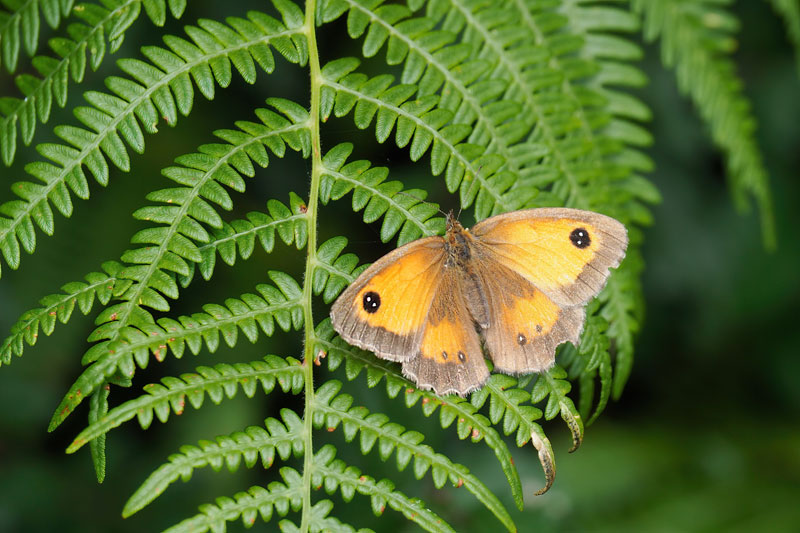
Both English names of the butterfly Pyronia tithonus indicate something of the species' habitat. Gatekeeper alludes to it commonly being found on flowers growing in gateways, whilst Hedge Brown describes how it likes hedgerows and field edges. The species' food plants include wild marjoram, common fleabane, ragworts, and bramble. This particular example - and others nearby - favoured bracken, but this was probably only used as a place on which to sun themselves. Gatekeepers exhibit some variation in their markings. The butterfly in the photograph has four small brown "eyes" as well as the big dark eyes with double white spots.
photo © T. Boughen Camera: Olympus OMD E-M10
Labels:
bracken,
butterfly,
Gatekeeper,
hedge brown
Wednesday, 5 August 2020
Chrysler Airstream Land Yacht
Walking along a footpath through the edge of a Herefordshire village we came upon a most unexpected sight - a Chrysler Airstream Land Yacht set up as a travelling photo booth. Its location suggested that it was parked up awaiting its next excursion. I'm familiar with the U.S. caravans known as Airstreams but the "Land Yacht" badged puzzled me. Apparently it simply distinguishes a "luxury" version of the caravan.
photo © T. Boughen Camera: Olympus OMD E-M10
Labels:
Airstream,
caravan,
Chrysler,
Land Yacht,
photo booth
Monday, 3 August 2020
The tallest hedge in Britain?
At our last house we had the unenviable task of cutting a hedge that was abut 120 feet long and 10 feet high. When I saw the hedge cutting featured in today's photograph I remembered our hedge and reflected that the job was as nothing compared with the task of keeping this monster in shape. I don't know whether this hedge at Cirencester Park is the tallest in Britain but there can't be many, if any, that surpass it. You might wonder why a country house that is surrounded by a stone wall as tall as that in the photograph needs a hedge behind it. It must, I think, be because the house is next to the streets and houses of the town and a taller barrier was felt necessary to preserve the privacy of the owners. Incidentally, watching this hedge cutting was probably the highpoint of our grandson's visit to Cirencester.
photo © T. Boughen Camera: Sony DSC-RX100
Saturday, 1 August 2020
Field maple leaf
It's a little early for deciduous trees to be losing their leaves but a field maple I know has begun to do so. I suspect that it is suffering distress because not on all the branches have the leaves taken on a yellow tinge rather than the usual deep green of summer. Field maples are popular hedging plants in some parts of Britain. Elsewhere thay are usually single, taller trees. In autumn they naturally turn a fine, golden yellow, matched only by the lime tree. This leaf had caught itself on the arris rail of a fence and, havng no camera to hand, I snapped it with my phone.
photo © T. Boughen Camera: Phone
Labels:
colour,
fence,
field maple,
leaf
Subscribe to:
Posts (Atom)