This photograph of a skylark with a beak full of insect for its brood was taken on the former RAF Woodhall Spa airfield in Lincolnshire. In WW2 this flat area of, essentially, lowland heath, was once a place where the ground and skies were crowded with Avro Lancaster four-engine bombers engaged in the bombing of occupied Europe. It then became a place where gravel was dug resulting in large stretches of open water and smaller pools. Today it is a nature reserve in the making and the skies are now filled with greylag geese, skylarks, black-headed gulls, little egrets, buzzards and much more. The obliging bird pictured above posed perfectly, allowing me to get off six hand-held shots, all of which were pretty sharp.
photo © T. Boughen Camera: Nikon P900
Monday, 19 June 2017
Saturday, 17 June 2017
Morning, Leadenhall Market, London
Leadenhall Market in London's financial district has the most decorative architecture of all the purpose-built London markets. It was built on the site of Roman London's basilica in 1881. However, the site had been in use as a market since at least the fourteenth century. It is essentially a collection of glazed arcades of the type that Victorian Britain erected in major cities for covered shopping. I came upon it during the morning, before the cafes and pubs had sprung into life, and enjoyed the shadows and pools of light that illuminated this section of the market.
photo © T. Boughen Camera: Sony DSC-RX100
Labels:
arcade,
cafe,
Leadenhall,
London,
market,
Victorian architecture
Thursday, 15 June 2017
Two giraffes and crazy paving
There was a fashion, around the time of my childhood, for "crazy paving". This seemed to involve taking perfectly serviceable rectangular concrete or stone paving slabs, breaking them into large pieces and laying them with narrow cement lines between the pieces. This had the advantage of, among other things, disguising the poor workmanship of an amateur because there were no unforgiving straight lines like those produced with unbroken slabs to reveal the novice's work. We recently went to a wildlife park with young children, and in observing giraffes more closely than I'd ever done before I was struck by the way their colouration resembled crazy paving.
photo © T. Boughen Camera: Nikon P900
Tuesday, 13 June 2017
Fishing boats, South End Quay, Boston
Finding a new photograph of a familiar subject that you have recorded before is part of the pleasure of photography. I've photographed the fishing boats by the quay at South End, Boston, on a couple of occasions before. I've also considered a shot from the location used in the photograph above (the bridge that carries John Adams Way over the River Witham). However, on those occasions the light was working against me: the other day it was better. Moreover, the new housing that has been under construction for a while is now almost complete and added considerably to the shot.
photo © T. Boughen Camera: Sony DSC-RX100
Sunday, 11 June 2017
Church Street & St Botolph, Boston, Lincolnshire
photo © T. Boughen Camera: Sony DSC-RX100
Labels:
church,
Church Street,
composition,
Lincolnshire,
medieval,
St Botolph,
Stump,
tower
Friday, 9 June 2017
Interloper barley
Nature is tenacious. The drive to grow, thrive and multiply is central to all living things. In an area of intensive agriculture such as the Fens it is harder than elsewhere for plants and animals to achieve this biological imperative.Where farmers grow wheat a regime of pesticides and herbicides aims to ensure that only the wanted crop grows. Consequently the much-liked poppies that traditionally accompany wheat are few and far between. However, the other day I came across three ears of barley in a green field of wheat. How did they get there? Were they a survival from a previous crop? Is it wild barley? Would they continue to grow and be harvested with the surrounding crop? I'll probably never know, but it was good to see these three stems marring the perfection of the pampered wheat.
photo © T. Boughen Camera: Olympus OMD E-M10
Labels:
agriculture,
barley,
Fens,
nature,
wheat
Wednesday, 7 June 2017
Algarkirk, a photogenic church
Structure and setting are, I think, the two main factors that determine the extent to which a church is photogenic, though light, of course, is capable of overriding all other considerations and can transform the mundane into the magical. St Peter and St Paul at Algarkirk has a fine structure courtesy of the original medieval builders and a sensitive restoration by the Victorians.The cruciform shape is complemented by mellow stonework, repeated and individualistic window tracery, battlements a-plenty and a short, culminating spirelet. Perhaps the tower could do with being wider, but apart from that it is a fine example of English church architecture. Its setting is typical of Fenland churches - a small village location, a surrounding churchyard, and plenty (but not too many) mature trees. Add a lovely May sky with soft, dishevelled clouds and you have all a photographer could ask for.
photo © T. Boughen Camera: Olympus OMD E-M10
Monday, 5 June 2017
Faded elelgance, Wisbech
There's an attraction in faded elegance. Perhaps it's glimpsing and still enjoying something of what was in what is.This late Georgian (early 1800s) building in Hill Street, Wisbech, must have been a town house for a well-to-do family. It is tastefully composed, well-proportioned, and uses brick and stone dressing in a minimalist sort of way. In fact, theses features contribute most to the success of the facade. More money and more decoration was, quite appropriately, given to the entrance with its Doric columns and Greek key pattern. Gentle subsidence and desultory maintenance have left it looking somewhat neglected, but its style still manages to shine through.
photo © T. Boughen Camera: Olympus OMD E-M10
Saturday, 3 June 2017
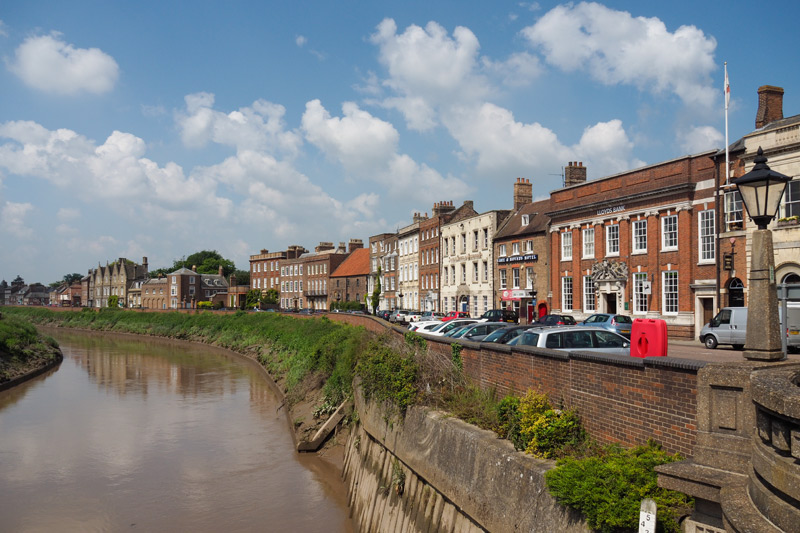
North Brink, Wisbech
In "The Buildings of England: Cambridgeshire", the architectural historian, Nikolaus Pevsner, describes the row of buildings on the street known as North Brink (above) as "one of the most perfect Georgian streets of England". He might have added, "and one of the least well known". The buildings are not entirely Georgian - a few from the Victorian period are there too - and they don't have the variety within uniformity that can be seen in, say, Bath or Stamford. And that may be where the pleasure of this street lies, in the marked difference between each building and its neighbour. For the photographer there are only two ways to photograph the whole street - from one end or the other, and I prefer the classic view from the bridge with the River Nene on the left of the composition.
photo © T. Boughen Camera: Olympus OMD E-M10
Thursday, 1 June 2017
Coleus plants
This photograph was taken in the cold frames of the gardens of Peckover House in Wisbech, Cambridgeshire. This large, Georgian town house is in the care of the National Trust. As I took my photograph I wondered why the gardeners were cultivating so many different varieties of the plant. Were they breeding new types? Were they for a colour themed display of this single type of plant? Whatever the reason, when viewed through my wide angle lens, as I leaned over the open cold frame, they made a splendid composition of circles and colours.
photo © T. Boughen Camera: Olympus OMD E-M10
Subscribe to:
Posts (Atom)